


Chemistry Chapter 13 – Carboxylic Acids (Class 12) for FSC, Entry Tests & NTS Preparation
Chapter 13, Carboxylic Acids, is an important topic for Class 12 students preparing for FSC board exams and medical/engineering entry tests like MDCAT, NUMS, AKU, NUST, ECAT, and NTS exams. This chapter explains the structure, nomenclature, physical and chemical properties, and reactions of carboxylic acids. Understanding carboxylic acids is essential for studying acid-base behavior, substitution, and addition reactions in organic chemistry.
PLS Boost Bundle
Get Access to 20 thousands+ MCQs Including Topical MCQs, Practice Tests, Mock Tests, Solved Past Papers, Flashcards, Notes, FLPS, and Much More.

Lysine is a
amino acid
Which of the following is not the physical property of acetic acid?
NUMS 2017
Chemistry
Carboxylic Acids and its Derivatives
Elimination Tool:
To get the carboxylic acid containing C atoms less than C atoms in parent aldehyde we do hydrolysis of:
Ease of esterification of the following alcohols CH3CH2OH(I),(CH3)2CHOH and (CH3)3COH(III) with HCOOH is:
NUMS 2017
Chemistry
Carboxylic Acids and its Derivatives
Elimination Tool:
What is common when carboxylic acid is reacted with base or with alcohol?
NUMS 2019 Cancelled
Chemistry
Carboxylic Acids and its Derivatives
Elimination Tool:
Which of the following is not an aromatic compound)
HCOOH is the structure of:
NUMS 2018
Chemistry
Carboxylic Acids and its Derivatives
Elimination Tool:
If 2-butene is treated with KMnO4 the product formed will be:
Which of the following is an example of aromatic carboxylic acid?
PMC Practice 2
Chemistry
Carboxylic Acids and its Derivatives
Elimination Tool:
Which one of the following compounds act as a catalyst when alcohols react with carboxylic acids.
UHS 2018
Chemistry
Carboxylic Acids and its Derivatives
Elimination Tool:
Reagent used to reduce a carboxylic acid to an alkane is:
NUMS 2019 Reconduct
Chemistry
Carboxylic Acids and its Derivatives
Elimination Tool:
Which of the following reagent is required for preparation of acyl chloride (CH3COCl) from ethanoic aicd?
UHS 2019
Chemistry
Carboxylic Acids and its Derivatives
Elimination Tool:
Fatty Acids are:
The carbonic acid which Is named after butter is:
Carboxylic acids are formed by the hydrolysis of ________.
PMC Practice 3
Chemistry
Carboxylic Acids and its Derivatives
Elimination Tool:
Which of the following is an example of Monocarboxylic acid?
PMC Sample 2
Chemistry
Carboxylic Acids and its Derivatives
Elimination Tool:
Which type of carboxylic acid is produced from the hydrolysis of nitriles?
PMC Sample 2
Chemistry
Carboxylic Acids and its Derivatives
Elimination Tool:
High molecular mass organic compounds, upon hydrolysis yield amino acids are called _______.
PMC Sample 3
Chemistry
Carboxylic Acids and its Derivatives
Elimination Tool:
Chemical formula of Malonic acid: b) CEI-11206
a) C3H804
Sodium Benzoate on reacting with soda lime forms:
NUMS 2015
Chemistry
Carboxylic Acids and its Derivatives
Elimination Tool:
Which of the following is correct general formula of aliphatic carboxylic acid ?
PMC Sample 3
Chemistry
Carboxylic Acids and its Derivatives
Elimination Tool:
The reaction CHCH + H2O + 3(O) shows the formation of ________.
NUMS 2018
Chemistry
Carboxylic Acids and its Derivatives
Elimination Tool:
) Acetic acid is used in making
Which one is the carbonyl protecting group?
Carboxylic acids form dimers due to _________.
PMC Practice 3
Chemistry
Carboxylic Acids and its Derivatives
Elimination Tool:
Which of the following carboxylic acids will be the most acidic?
NUMS 2016
Chemistry
Carboxylic Acids and its Derivatives
Elimination Tool:
Chemical formula of Malonic acid:
What is the least number of carbon atoms in amino acids?
There is double bond in oleic acid between carbon numbers:
Acetic anhydride is a product of acetic acid, as a result of the following reaction:
NUMS 2020
Chemistry
Carboxylic Acids and its Derivatives
Elimination Tool:
The compounds having -COOH group are called as_______?
PMC Sample 2
Chemistry
Carboxylic Acids and its Derivatives
Elimination Tool:
Which of the following is the strongest acid?
PMC 2020
Chemistry
Carboxylic Acids and its Derivatives
Elimination Tool:
Solubility of carboxylic acids in water decrease with
Solubility of carboxylic acids ______?
PMC Sample 1
Chemistry
Carboxylic Acids and its Derivatives
Elimination Tool:
Which of the following cannot be used to convert butanoic acid to butanoyl chloride?
NUMS 2016
Chemistry
Carboxylic Acids and its Derivatives
Elimination Tool:
) Which of the following is not a use of acetic acid?
Which one of these is a soluble carbohydrate:
Cyanohydrins when reacted with mineral acid produces ________?
PMC Sample 2
Chemistry
Carboxylic Acids and its Derivatives
Elimination Tool:
Which of the following acid solutions is used for the seasoning of food?
PMC Practice 3
Chemistry
Carboxylic Acids and its Derivatives
Elimination Tool:
What happens if we react a carboxylic acid with an acyl chloride?
NUMS 2019 Cancelled
Chemistry
Carboxylic Acids and its Derivatives
Elimination Tool:
Hydrolysis of acyl chloride results in the formation of:
PMC 2020
Chemistry
Carboxylic Acids and its Derivatives
Elimination Tool:
The formula of esters is
PMC Sample 2
Chemistry
Carboxylic Acids and its Derivatives
Elimination Tool:
Which one will act as a strong acid?
UHS 2018
Chemistry
Carboxylic Acids and its Derivatives
Elimination Tool:
Benzyl acetate gives us which flavour?
NUMS 2019 Cancelled
Chemistry
Carboxylic Acids and its Derivatives
Elimination Tool:
In IUPAC nomenclature, Carboxylic acids are named as_______?
PMC Sample 3
Chemistry
Carboxylic Acids and its Derivatives
Elimination Tool:
In the case of HOCH2CH2CH2COOH, from where is numbering started?
PMC Practice 2
Chemistry
Carboxylic Acids and its Derivatives
Elimination Tool:
Which of the following carboxylic acids is used in medicine as a local irritant?
PMC Practice 2
Chemistry
Carboxylic Acids and its Derivatives
Elimination Tool:
Which of the following is most soluble in water?
PMC Practice 1
Chemistry
Carboxylic Acids and its Derivatives
Elimination Tool:
Nitriles (RCN), on hydrolysis, in the presence of a mineral acid yield:
UHS 2019
Chemistry
Carboxylic Acids and its Derivatives
Elimination Tool:
What is correct order of acidic strength?
Carboxylic acids do not give the characteristics reaction of >C=O group because of:
PMC Practice 1
Chemistry
Carboxylic Acids and its Derivatives
Elimination Tool:
What is the product of both fermentation reactions and fractional distillation:
NTS 2010
Chemistry
Carboxylic Acids and its Derivatives
Elimination Tool:
Which one of the following is neutral amino acid:
Strongest acid among the following is:
NUMS 2014
Chemistry
Carboxylic Acids and its Derivatives
Elimination Tool:
By treating CO2 with Grignard’s reagent, the following compound is obtained;
NUMS 2019 Cancelled
Chemistry
Carboxylic Acids and its Derivatives
Elimination Tool:
In esterification, alcohol reacts with:
Acetic acid is used in treatment of?
Carboxylic acids can be prepared by action of and carbon dioxide
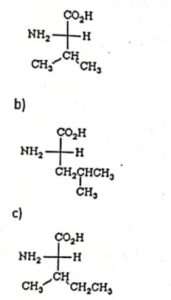
Which of the following is branched amino acid?
Which of the following is used as coagulation for latex in rubber industry
Acetic acid is used in curing of? b
An ester is prepared by the reaction of:
NTS 2011
Chemistry
Carboxylic Acids and its Derivatives
Elimination Tool:
Chemical formula of MaIonic Acid is?
Carboxylic acid reduction to alcohol can be achieved by using?
PMC Sample 3
Chemistry
Carboxylic Acids and its Derivatives
Elimination Tool:
Which of these in an aqueous solution of equal concentration has the lowest pH?
NUMS 2019 Cancelled
Chemistry
Carboxylic Acids and its Derivatives
Elimination Tool:
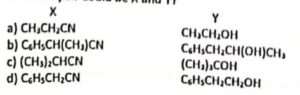
The same carboxylic acid is obtained either by hydrolysis of a nitrite X or by oxidation of alcohol Y. Which pair could be X and Y? X Y
For preparation of carboxylic acid, alkyl nitrite is required. Alkyl nitrite can be prepared by treating KCN with:
Hydrolysis of Nitriles produces:
NUMS 2020
Chemistry
Carboxylic Acids and its Derivatives
Elimination Tool:
Which type of carboxylic acid is produced from the hydrolysis of nitriles?
PMC Practice 3
Chemistry
Carboxylic Acids and its Derivatives
Elimination Tool:
Vinegar is basically acid:
Which of the following reagents will reduce butanoic acid to butanol?
NUMS 2016
Chemistry
Carboxylic Acids and its Derivatives
Elimination Tool:
On reacting with which of the following carboxylic acids produce CO₂?
PMC Sample 1
Chemistry
Carboxylic Acids and its Derivatives
Elimination Tool:
Carboxylic acids can be reduced to corresponding alcohols. Which of the following reagent can be used for this purpose?
UHS 2019
Chemistry
Carboxylic Acids and its Derivatives
Elimination Tool:
Amino acids are prepared by?
An ester is prepared by:
NUMS 2014
Chemistry
Carboxylic Acids and its Derivatives
Elimination Tool:
Amino acid is usually known by a
Acetic acid derived from the word ‘Acetum’ which means_______?
PMC Sample 1
Chemistry
Carboxylic Acids and its Derivatives
Elimination Tool:
Which one has fruity smell?
Key Concepts about Carboxylic Acids
The chapter explains the classification of carboxylic acids, IUPAC nomenclature, and functional groups. It covers their physical properties, acidity, and hydrogen bonding effects. The chapter also discusses important reactions such as esterification, reduction, halogenation, and decarboxylation. Applications of carboxylic acids in pharmaceuticals, polymers, and industrial processes are also highlighted. Each concept is illustrated with examples, diagrams, and step-by-step explanations. These concepts are highly important for FSC board exams and entry tests like MDCAT, NUMS, AKU, NUST, and ECAT.
Free Entry Test Preparation
Mastery of carboxylic acids helps students understand reaction mechanisms, predict products, and solve numerical and conceptual problems. PLS Academy provides practice questions, solved past papers, and chapter-wise MCQs to help students revise these topics effectively. Regular study of this chapter improves problem-solving skills, conceptual clarity, and exam performance, ensuring students are well-prepared for FSC board exams, competitive entry tests, and NTS exams.
JazakAllah.